Explained · Materials
Is a carbon fiber iPhone case worth it in 2026? Real carbon vs aramid vs carbon-look, the signal and MagSafe truth, and who should actually buy one.

It's one of the most asked questions in phone accessories, and one of the most misunderstood: is a carbon fiber iPhone case worth it? The short version is that it depends entirely on what "carbon fiber" actually means on the listing you're looking at - because the vast majority of cases sold under that name aren't structural carbon fiber at all. Once you understand why, the buying decision gets a lot clearer.
This is an educational piece, written to make the material question genuinely clear, with a light touch of where Creslia's own carbon-look line fits. It's brand-owned, not sponsored, so where we mention our cases we'll be precise about what they are and aren't. Let's separate the engineering from the marketing.
What Carbon Fiber Actually Is

Carbon fiber is exactly what it sounds like: incredibly thin strands of carbon, thinner than a human hair, woven into a fabric and locked in place with resin. The result is a composite that's famous for one thing - an extraordinary strength-to-weight ratio. It's stiff, it's light, and it's why you find it in Formula 1 monocoques, aircraft panels, and high-end bike frames where shaving grams while keeping rigidity is worth almost any price.
Here's the catch that marketing rarely mentions: those aerospace virtues don't automatically translate to a phone case. A race car uses carbon fiber as a structural chassis bearing real loads. A phone case is a thin shell wrapped around a device that already has its own aluminum frame. The carbon isn't doing structural work in any meaningful sense - so most of what you're paying for, in a genuine carbon case, is the look and the story, not a measurable leap in protection.
And there's a property that makes real carbon fiber actively awkward for phones, which the next sections get into: it conducts electricity. That single fact quietly shapes the entire "carbon fiber case" market.
It helps to be clear about what carbon fiber is genuinely great at, because the strengths are real - just mismatched to this product. Its appeal is stiffness without weight, fatigue resistance over millions of stress cycles, and dimensional stability across temperature swings. Those matter enormously when the part is load-bearing and every gram counts at speed or altitude. A phone case is none of those things. It's a protective wrapper, not a structural member, and the loads it sees are drops and pocket pressure, where a little flex to absorb impact is actually a virtue. So the irony is that carbon fiber's defining trait - rigidity - is arguably the wrong property for the job, while its conductivity is an outright liability. Understanding that flips the usual assumption: more "real" carbon is not automatically better here.
Real Carbon Fiber vs Aramid vs Carbon-Look: The Three Options

When a case says "carbon fiber," it's almost always one of three very different things. Knowing which one you're buying is the whole game.
1. Pure / resin carbon fiber
The genuine article - woven carbon set in resin into a rigid shell. It looks and feels premium and it's stiff. But it's electrically conductive, which means a solid carbon shell can shield your phone's antennas and weaken cellular, Wi-Fi and GPS reception, and it can interfere with MagSafe alignment. It's also rigid rather than shock-absorbing, so it doesn't flex to soak up a drop. For a working everyday phone, those drawbacks are real.
2. Carbon-textured TPU or polycarbonate
The cheapest interpretation: ordinary plastic molded or printed with a carbon-look texture. It's MagSafe-safe and inexpensive, but it offers none of carbon's structural character, and the surface texture tends to wear smooth and shiny over time. It's a costume, not a material upgrade.
3. Aramid / aramid-carbon composite
The sweet spot. Aramid fibers are the same Kevlar family used in protective gear - thin, tough, and crucially non-conductive. An aramid-style or carbon-look composite gives you the woven appearance and a slim, grippy feel without blocking signal or fighting MagSafe. This is what most reputable "carbon fiber" cases actually are, and it's the version genuinely worth buying.
| Type | Conducts electricity? | Signal / MagSafe | Protection | Typical price |
|---|---|---|---|---|
| Pure / resin carbon fiber | Yes | Can weaken signal & MagSafe | Rigid, doesn't flex | High |
| Carbon-look TPU / PC | No | MagSafe-safe | Basic; texture wears | Low |
| Aramid / carbon-look composite | No | Full signal & MagSafe | Slim, tough, grippy | Mid |
Bottom line of the table: the conductive one is the one that causes problems. The non-conductive aramid-style composite is the version that delivers the look and feel without the downsides.
Signal & MagSafe: The Conductivity Point, Plainly
This is the part most "carbon fiber case" reviews skip, and it's the most important. Your phone's antennas radiate radio waves through the case. Conductive materials interfere with that. Because genuine carbon fiber conducts electricity, a solid carbon shell can act a little like a partial shield around the antennas - and reported reception losses commonly land in the rough 40 to 60 percent range depending on how the case is built. The same conductivity can disrupt the magnetic and wireless handshake that MagSafe relies on.
That's the real reason the market quietly runs on look-alikes. A non-conductive aramid-style or carbon-look composite sidesteps the problem entirely: the radio waves pass through, the antennas work normally, and a built-in magnet ring keeps MagSafe aligned. You get the carbon aesthetic with zero signal tax. For context on why that magnet ring matters so much, our explainer on MagSafe vs wireless charging walks through how magnetic alignment actually works - including that MagSafe now reaches up to 25W on iPhone 16 and 17 (and 15W on iPhone 12 through 15).
The carbon-fiber look people want and the signal performance they need only coexist in the non-conductive versions.
Put it in everyday terms. A weakened antenna doesn't usually announce itself with "no service" - it shows up as a bar or two lost in a marginal area, slower data at the edge of Wi-Fi range, or GPS that takes a beat longer to lock when you're navigating. Most people would never connect those small frustrations to their case, which is exactly why the conductivity issue is so easy to sell around. The honest fix isn't to tolerate a little signal loss for the look; it's to choose a material that was never going to cause it. Non-conductive composites give you that for free, so there's simply no reason to accept the tradeoff a solid carbon shell asks of you.
Weight, Heat, Durability & Aging - Honestly
Set the marketing aside and judge a carbon-style case the way you'd judge any case: how it feels and how it ages.
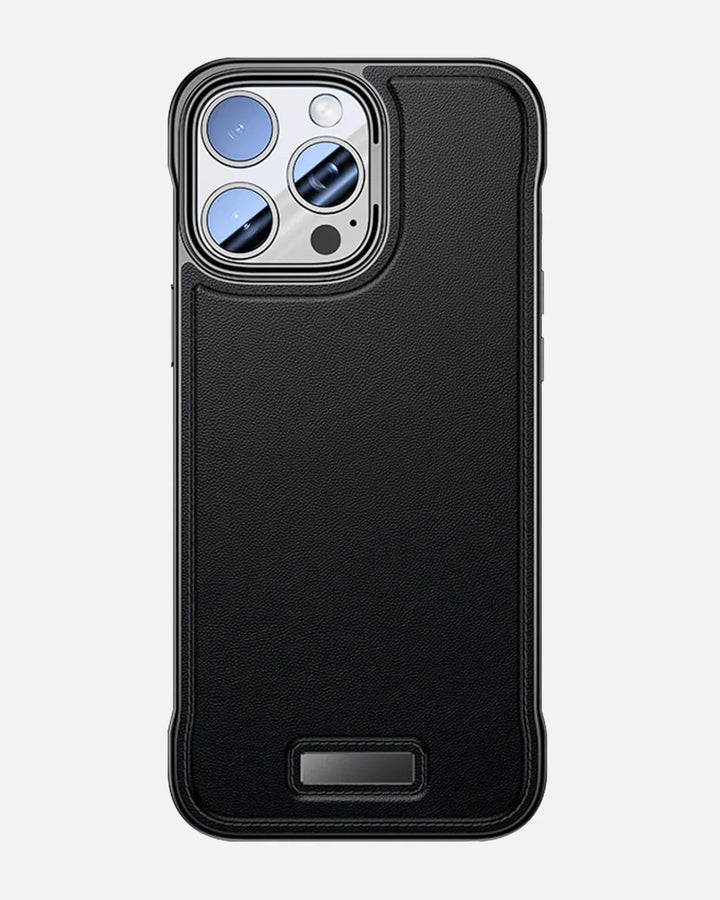
Weight and feel. This is where carbon-style cases genuinely shine. Aramid-style composites are remarkably thin and light, so the phone keeps its slim profile and gains a subtle, grippy texture that's easier to hold than slick glass or glossy plastic. If "barely there but not slippery" is your goal, the material delivers.
Heat. A common myth is that a carbon case meaningfully cools your phone. In a thin case, any effect on heat dissipation is negligible - your phone manages its own thermals through its frame and internal design. Don't buy for cooling.
Durability and aging. A slim carbon-style case protects against scuffs, minor drops and everyday wear, and a matte woven finish hides micro-scratches better than high gloss. But be realistic: a thin shell is not armor. It won't match a dual-layer rugged case with reinforced corners for serious drops. On aging, the better composites hold their texture well; the cheap carbon-look TPUs are the ones that go smooth and shiny at the edges. Fingerprints are rarely an issue on a matte woven surface, which is a quiet daily win over glossy cases.
Grip. This deserves its own line because it's the benefit people notice most in week one. Glass-backed phones are slippery, and a slick case barely helps; a fine woven texture gives your fingers something to hold without the tackiness of soft silicone that grabs lint and pocket fabric. It's the kind of small, constant improvement you stop consciously noticing precisely because it's working - the phone simply feels more secure in hand, on a car vent, or propped against a mug. For a lot of buyers, that everyday confidence is the real reason a carbon-style case earns its keep, more than any claim about the material itself.
There's a timely reason a slim case makes sense on the latest iPhones specifically. The iPhone 17 line moved to an aluminum chassis - lighter than the titanium of the 15 and 16 Pro, but softer and more prone to scuffs. A thin carbon-style case covers that frame without adding bulk, and the woven finish complements aluminum's clean look. It's a genuine fit, no titanium myth required.
What Creslia Uses (and Why)
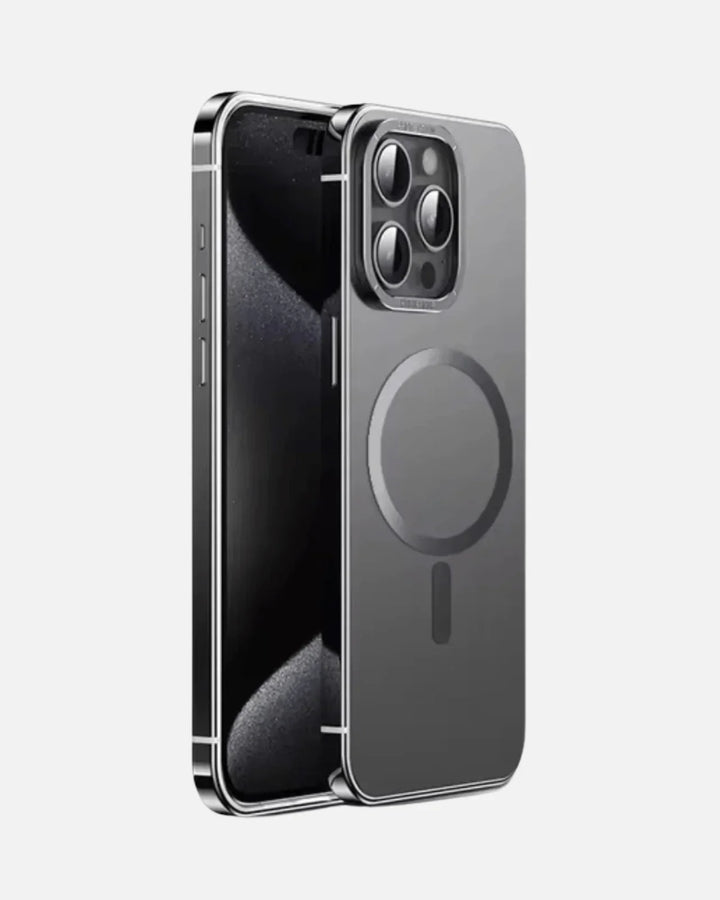
Straight answer, because vague material claims are exactly what this article is pushing back on: Creslia's carbon-look cases use an aramid-style, carbon-look composite that is non-conductive, over a protective polycarbonate build, with an N52 magnet ring for full MagSafe alignment. We deliberately don't use a solid structural-carbon shell, precisely because that's the version that can choke signal and fight MagSafe. The goal is the woven carbon look and the slim, grippy feel - with your reception and magnetic charging fully intact.

The line comes in four patterns at $29.99 - Classic Plaid for understated and professional, Knitted for a softer texture, Mountain Horizon for a graphic motif, and Racing Stripes for a sportier look. They're tested to MIL-STD-810G methods, which is an environmental and drop-test methodology rather than a military certification, so treat them as smart slim-protective cases rather than heavy armor. For the wider range, the full iPhone case collection includes rugged options if maximum protection is your priority.
On price: premium carbon and aramid brands frequently sit around $50 to $60. At $29.99, the value question mostly answers itself - paying more rarely buys meaningfully better everyday performance from a thin case, because the things that matter most here (non-conductive material, a proper magnet ring, clean fit) don't get better with a bigger price tag.
It's also worth saying plainly why we describe the material the way we do. It would be easy, and probably better for marketing, to stamp "real carbon fiber" on the box - the phrase sells. But it wouldn't be true of a case that keeps your signal and MagSafe intact, and a brand that explains why solid carbon hurts reception can't then claim to use solid carbon in the same breath. So we call it what it is: an aramid-style, carbon-look composite. The look is genuine, the feel is genuine, and the performance is honest. If you've seen the term "real woven carbon fiber" used loosely elsewhere for cases like these, this is the more accurate way to think about what you're actually holding.
How to Tell What You're Actually Buying
Because three very different products share one label, the listing won't always make the material obvious. A few reliable tells separate the real-deal composites from the costume plastic before you spend.

Start with the language. Honest listings name the material plainly - "aramid," "aramid-style," or "carbon-look composite" - and tell you it's non-conductive and MagSafe-compatible. Vague phrasing like "carbon fiber texture" usually signals a printed or molded TPU, which is fine if you only want the look and a low price, but don't pay a premium for it. If a listing claims a solid, genuine carbon-fiber shell and promises flawless signal and MagSafe, treat that as a contradiction worth questioning, because the two rarely come together.
Then check the practical specs. A real composite case will state a MagSafe magnet ring (look for an N52 reference) and confirm wireless charging works through the shell; a costume TPU often stays quiet on magnets. Feel, if you can: aramid-style composites have a fine, dry, woven texture with subtle depth, while printed plastic feels slick and uniform under the pattern. And mind the price logic in both directions - a $10 "carbon" case is plastic, while a $60 one isn't necessarily better than a well-made $30 composite. The sweet spot is a clearly-labeled non-conductive composite with a real magnet ring at a fair price.
Is It Worth It? - By Buyer Type
"Worth it" is personal, so here's the honest read for each kind of buyer, including who should skip it.
Get the carbon look, keep your signal
Creslia's carbon-look MagSafe cases - aramid-style, non-conductive, $29.99. Free shipping over $49.90, same-day dispatch before 3 PM ET.
Shop carbon-look cases →Frequently Asked Questions
Is a carbon fiber iPhone case worth it?
For most people, a carbon-look or aramid-style case is worth it for the slim feel and premium look rather than for any structural superpower. True structural carbon fiber is overkill for a phone and can interfere with signal and MagSafe, so the versions worth buying are the non-conductive aramid-style and carbon-look composites. If you want the aesthetic and a thin, grippy case, yes; if you expect armor-level protection, a rugged case is a better value.
Are most carbon fiber phone cases actually real carbon fiber?
No. Most cases sold as carbon fiber are either a carbon-look textured TPU or polycarbonate, or an aramid-style composite from the Kevlar family. Genuine structural carbon fiber is electrically conductive, which can reduce cellular, Wi-Fi and GPS signal and disrupt MagSafe alignment, so it is rarely used in a working phone case. The non-conductive look-alikes give you the appearance without the interference.
Does carbon fiber block phone signal?
Real carbon fiber can. Because it conducts electricity, a solid carbon-fiber shell can shield the antennas and weaken cellular, Wi-Fi and GPS reception, with reported losses commonly in the rough 40 to 60 percent range depending on design. Aramid-style and carbon-look composite cases are non-conductive, so they do not block signal and keep MagSafe working normally.
Do carbon fiber cases work with MagSafe?
Aramid-style and carbon-look cases work with MagSafe when they include a magnet ring, because they are non-conductive. Creslia's carbon-look cases use an N52 magnet ring for full MagSafe alignment. A solid real-carbon-fiber shell, by contrast, can interfere with the magnetic and wireless connection, which is another reason genuine structural carbon is uncommon in cases.
What material does Creslia use in its carbon fiber cases?
Creslia's carbon-look cases use an aramid-style, carbon-look composite that is non-conductive, paired with a protective polycarbonate build and an N52 MagSafe magnet ring. That combination gives the woven carbon appearance and a slim, grippy feel while keeping full signal and MagSafe performance, which solid structural carbon fiber cannot reliably promise.
Is carbon fiber stronger than a regular phone case?
In aerospace and automotive use, carbon fiber composites are very strong for their weight, but a thin case layer does not turn your phone into a tank. A carbon-look or aramid-style case is about a slim profile, grip and looks, not maximum impact protection. For heavy drop protection, a dual-layer rugged case with reinforced corners does more than a thin carbon-style shell.
Do carbon fiber cases fit the iPhone 17?
Yes, when bought for the correct model. The iPhone 17 uses an aluminum chassis that is lighter but softer and more prone to scuffs than the older titanium Pro frames, which makes a slim case a sensible choice. Always select your exact model, because camera and body geometry change between generations and an older case will misalign the camera cutout.
How much should a good carbon fiber iPhone case cost?
Premium carbon and aramid brands often charge around $50 to $60. Creslia's carbon-look MagSafe cases are $29.99, which covers the slim aramid-style build, the carbon-look finish and a full N52 MagSafe ring. Paying more rarely buys meaningfully better everyday performance from a thin case, so value matters more than a high price tag here.
The Bottom Line
So, is a carbon fiber iPhone case worth it? If you want the woven look and a slim, grippy feel, yes - provided you buy the non-conductive kind. The version worth your money isn't solid structural carbon, which can cost you signal and MagSafe for benefits a phone doesn't need; it's the aramid-style, carbon-look composite that delivers the aesthetic with your reception and magnetic charging fully intact. Judge it as a stylish, thin everyday case rather than armor, match the price to that reality, buy for your exact model, and it's an easy yes. Expecting it to bulletproof your phone or supercharge your reception is where buyers go wrong.
Why trust Creslia
- 2,000+ products tested in our Iselin, NJ QA lab since 2024.
- 200+ device models supported - iPhone, Samsung, Pixel, OnePlus, Google.
- Same-day shipping on orders placed before 3 PM ET, six days a week.
- Reviewed under MIL-STD-810G drop methodology for our rugged lines.